
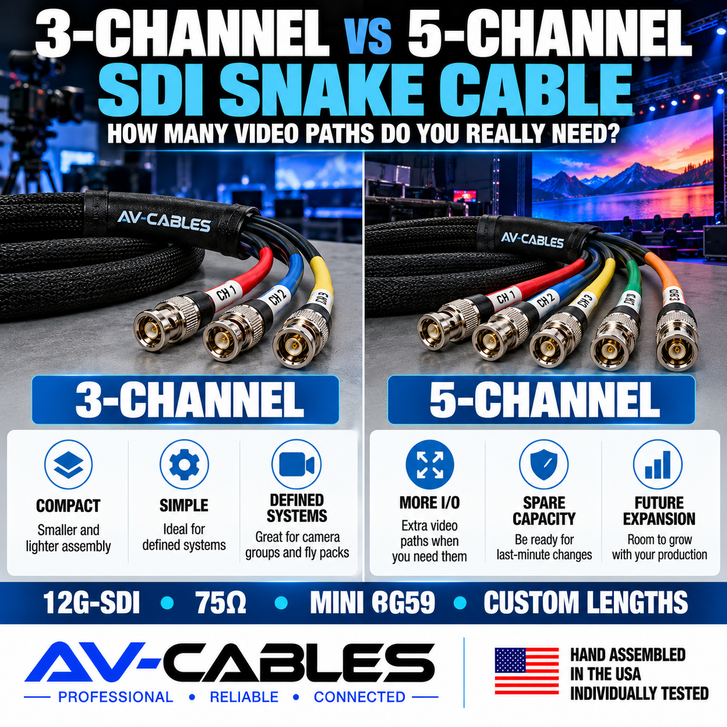
When several SDI signals need to travel between the same two locations, running individual BNC cables can quickly become difficult to organize.
A multi-channel SDI snake cable keeps those individual video paths together in one organized assembly while providing separate BNC connections at each end.
But how many channels should the snake have?
For many professional video systems, the decision comes down to a 3-channel or 5-channel SDI snake.
The right answer depends on the number of signals you need today, how the system may expand and whether having a spare channel could save a production when something unexpected happens.
WHAT IS A CHANNEL IN AN SDI SNAKE?
Each channel in an SDI snake is an independent coaxial signal path.
A 3-channel snake contains three separate coaxial lines. A 5-channel snake contains five.
At each end, the individual channels break out from the main bundled trunk and terminate in their own BNC connectors.
3-CHANNEL VS 5-CHANNEL SDI SNAKE
| Feature | 3-Channel Snake | 5-Channel Snake |
|---|---|---|
| SDI Paths | 3 | 5 |
| Overall Size | Smaller | Larger |
| Best Fit | Smaller systems with a known number of signals | Systems needing more I/O or spare capacity |
| Expansion Capacity | Limited if all three channels are already assigned | Additional channels can provide room for expansion |
| Typical Applications | Camera groups, racks, small fly packs | Larger camera systems, production racks, mobile systems |
WHEN A 3-CHANNEL SDI SNAKE MAKES SENSE
A 3-channel snake is a practical choice when the application consistently requires three or fewer SDI connections between the same locations.
For example, three channels could be assigned as:
Channel 1: Camera 1
Channel 2: Camera 2
Channel 3: Camera 3
Another system might use them differently:
Channel 1: Program video
Channel 2: Preview or return video
Channel 3: Backup or auxiliary feed
If the system requirements are well defined and unlikely to expand, a 3-channel assembly keeps the snake compact while eliminating the need to run three separate loose cables.
WHEN A 5-CHANNEL SDI SNAKE IS THE BETTER CHOICE
A 5-channel snake provides two additional independent signal paths.
That extra capacity can be useful even when the production currently requires only three or four channels.
For example:
Channel 1: Camera 1
Channel 2: Camera 2
Channel 3: Camera 3
Channel 4: Return / confidence feed
Channel 5: Spare
That fifth channel may seem unnecessary during normal operation, but a spare signal path can become extremely valuable during a live production.
THE VALUE OF A SPARE SDI CHANNEL
Productions change.
An additional camera may be added. A return monitor may suddenly be needed. A piece of equipment may need a dedicated feed that was not part of the original system design.
A spare channel gives the production team another physical SDI path without running another cable across the venue.
It can also provide an alternate path if a connector or individual channel is damaged during setup.
THINK ABOUT THE ENTIRE SIGNAL FLOW
Don't choose channel count only by counting cameras.
Professional productions may need SDI paths for:
- Camera feeds
- Program outputs
- Preview feeds
- Return video
- Multiview feeds
- Replay systems
- Recording feeds
- LED video processors
- Backup signal paths
Map the complete signal flow between the two locations before deciding how many channels the snake needs.
12G-SDI SNAKES FOR UHD VIDEO
Channel count is only one part of selecting the assembly.
The individual coaxial paths also need to support the required video format and transmission distance.
For UHD production systems, a properly designed 12G-SDI snake cable can carry independent 12G-SDI signals through each channel when the complete assembly is appropriate for the required distance and equipment.
Professional 12G-SDI cable assemblies maintain the 75-ohm signal path required by SDI video systems.
Always consider the complete cable construction, connectors and length rather than assuming that every BNC snake is suitable for 12G-SDI.
WHY MINI RG59 WORKS WELL IN MULTI-CHANNEL SNAKES
Bundling multiple coaxial cables together can create a large and heavy assembly.
This is one reason compact Mini RG59 constructions can be useful in multi-channel SDI snakes.
A smaller coax diameter helps reduce the overall size of the bundle while maintaining independent 75-ohm video paths.
For 12G-SDI applications, AV-Cables uses professional cable constructions such as Belden 4855R Mini RG59 in appropriate assemblies.
BREAKOUT LENGTH MATTERS
Channel count isn't the only customization worth considering.
The breakout—or fanout—is the section where the individual coaxial cables separate from the main snake bundle.
Too little breakout length can make it difficult to reach equipment connections spread across a rack.
Too much can create unnecessary loose cable around the equipment.
Think about where the trunk will terminate and how far apart the individual BNC connections are located.
A properly sized breakout makes the snake easier to route, connect and service.
LABEL EVERY CHANNEL
A multi-channel cable only improves organization if technicians can quickly identify the individual signal paths.
Each breakout should be clearly identified at both ends.
For permanent systems, the labels can also correspond to equipment or signal assignments.
For portable systems that are frequently reconfigured, simple permanent channel numbers usually provide more flexibility.
WHERE MULTI-CHANNEL SDI SNAKES ARE USED
Three- and five-channel SDI snakes can be useful anywhere multiple professional video signals repeatedly travel between the same two locations.
Common applications include:
- Broadcast studios
- Production trucks
- Fly packs
- Live-event production
- Camera systems
- Houses of worship
- Corporate AV
- Sports production
- Production switchers and routers
- LED video wall systems
WHEN INDIVIDUAL SDI CABLES ARE BETTER
A snake is not automatically the best solution for every installation.
If each SDI connection travels to a completely different location, individual cables may provide greater routing flexibility.
Snakes provide the greatest advantage when several signal paths share most of the same physical route.
For example, five camera feeds traveling from the same stage position to the same production rack are a strong candidate for a snake.
Five cables traveling to five unrelated areas of a facility probably are not.
3 OR 5 CHANNELS? QUICK DECISION GUIDE
Choose 3 channels when:
- You consistently need three or fewer SDI paths
- Compact size is a priority
- The system configuration is unlikely to expand
- You already have another backup path available
Consider 5 channels when:
- You currently need four or five signals
- You want spare capacity
- The production frequently changes
- Future expansion is likely
- Running another cable later would be difficult
THE BOTTOM LINE
The best SDI snake isn't necessarily the one with the most channels.
It's the one that provides the right number of signal paths for the production while keeping the system manageable.
A 3-channel SDI snake can be an efficient solution for smaller, well-defined systems.
A 5-channel SDI snake provides additional flexibility and can leave room for return video, another camera or a spare channel.
Whichever configuration you choose, also consider the required SDI format, cable construction, total distance, breakout length and channel identification.
NEED A MULTI-CHANNEL SDI SNAKE?
AV-Cables builds professional multi-channel SDI cable assemblies for broadcast, live production, camera systems, fly packs, production racks and custom AV applications.
Need a specific channel count, length or breakout configuration? Contact AV-Cables about your application.
Hand assembled in the USA and individually tested.
AV-Cables — Professional • Reliable • Connected