
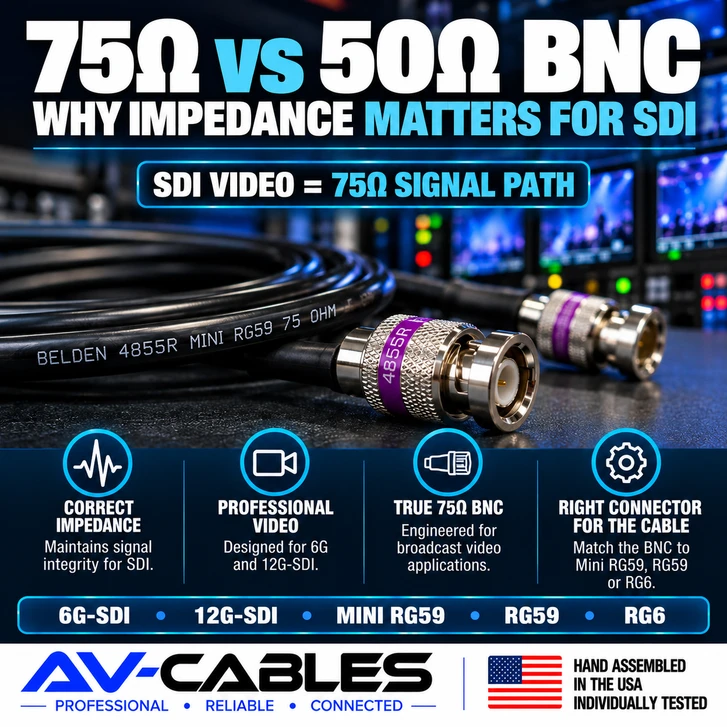
BNC connectors all look fairly similar from across a rack.
But electrically, they are not all designed for the same job.
One of the most important differences is impedance. BNC systems are commonly designed around either 50 ohms or 75 ohms, and choosing the correct impedance is especially important in professional SDI video systems.
So what's the difference between a 50-ohm and 75-ohm BNC connector—and why should a broadcast engineer, integrator or video technician care?
Let's break it down.
WHAT DOES 75 OHM BNC MEAN?
The 75-ohm specification refers to the characteristic impedance of the transmission system.
Professional digital video systems using coaxial cable are designed around a 75-ohm signal path.
That signal path includes more than the cable itself.
It can include:
- Coaxial cable
- BNC connectors
- Patch panels
- Adapters and couplers
- Equipment inputs and outputs
Ideally, the transmission path maintains the correct impedance from the source to the destination.
AV-Cables offers professional BNC cable assemblies for broadcast video and other coaxial applications.
WHAT IS A 50 OHM BNC CONNECTOR USED FOR?
50-ohm BNC connectors are commonly associated with RF, radio, test equipment and other applications built around a 50-ohm transmission system.
There is nothing inherently wrong with a 50-ohm BNC connector.
It is simply designed for a different electrical environment.
50 ohm: commonly used for RF and other 50-ohm systems.
The important point is to match the connector and cable to the system in which they are being used.
WHY DOES IMPEDANCE MATTER FOR SDI?
SDI is a high-speed digital signal traveling through a controlled-impedance transmission path.
Whenever the signal encounters an impedance discontinuity, some of its energy can be reflected rather than continuing cleanly toward the receiving device.
At lower data rates or on short connections, a marginal installation may appear to work.
As the data rate and transmission distance increase, however, maintaining a properly designed signal path becomes increasingly important.
This is one reason professional SDI assemblies use true 75-ohm coaxial connectors rather than selecting a connector simply because it physically fits the BNC jack.
CAN A 50 OHM BNC PHYSICALLY CONNECT TO A 75 OHM BNC?
Depending on the particular connector design, BNC connectors from different impedance systems may appear mechanically similar enough that someone assumes they are interchangeable.
That is exactly why impedance is easy to overlook.
A connector physically attaching to the equipment does not mean it is the correct electrical component for the signal path.
For professional SDI video, use components designed for a 75-ohm transmission system.
WHAT DOES “TRUE 75 OHM BNC” MEAN?
When a connector is described as a true 75-ohm BNC, its internal geometry is engineered to maintain the required impedance through the connector.
This matters because the connector becomes part of the transmission line.
AV-Cables uses professional 75-ohm BNC connectors on its SDI cable assemblies, including connector families designed for specific coax sizes such as Mini RG59, RG59 and RG6.
You can also view our true 75-ohm female BNC connector for RG59.
75 OHM BNC AND 12G-SDI
The importance of the complete transmission path becomes particularly noticeable with high-bandwidth signals such as 12G-SDI.
12G-SDI carries substantially more data through the coaxial path than earlier SDI formats.
The cable, connector and termination quality all contribute to overall signal integrity.
That is why a professional 12G-SDI assembly should not be treated as simply “a piece of coax with BNC connectors.”
AV-Cables builds 12G UHD-SDI BNC cable assemblies using components selected for professional video applications.
THE CONNECTOR MUST ALSO MATCH THE CABLE
Impedance isn't the only specification that matters when selecting a BNC connector.
The connector must also be designed for the physical coax construction.
For example, professional video systems may use:
- Mini RG59
- RG59
- RG6
- Flexible coax
- Plenum-rated coax
These cables do not all have the same outside diameter or internal construction.
A connector intended for RG6 should not simply be substituted onto Mini RG59 because both cables happen to be 75-ohm coax.
The correct connector must match both the electrical requirement and the physical cable construction.
MINI RG59 AND 75 OHM BNC
Mini RG59 is widely useful where cable size and routing density matter.
For example, Belden 4855R provides a compact coax option for professional 12G-SDI applications.
Because the cable is physically smaller than standard RG59 and RG6, it requires a connector specifically designed for its dimensions.
AV-Cables offers Kings 2065-11-9 true 75-ohm BNC connectors for compatible Mini RG59 applications.
RG59 AND 75 OHM BNC
Standard RG59 provides another useful cable size for professional video applications.
Depending on the cable construction and required SDI data rate, RG59 can provide a balance between physical size and transmission capability.
Again, the connector should be selected for the exact coax being terminated.
For professional RG59 installations, AV-Cables carries Kings true 75-ohm BNC connectors for RG59.
RG6 AND 75 OHM BNC
RG6 is physically larger and is often selected where lower attenuation over longer cable distances is valuable.
The larger cable construction requires the appropriate RG6 connector.
AV-Cables carries the Kings 2065-10-9 true 75-ohm BNC connector for RG6.
This illustrates an important point:
Mini RG59, RG59 and RG6 can all be part of 75-ohm systems while requiring different connector designs.
WHAT ABOUT BNC COUPLERS?
Sometimes two BNC cables need to be joined.
The coupler becomes another component in the transmission path, so its electrical performance matters too.
For professional 12G-SDI applications, AV-Cables offers the Canare BCJ-JK 12G-SDI 75-ohm BNC female-to-female coupler.
Using a purpose-designed video coupler helps maintain a professional 75-ohm signal path when a connection must be extended or joined.
CAN THE WRONG BNC CONNECTOR CAUSE SDI PROBLEMS?
A poor or inappropriate termination can contribute to signal-integrity problems.
Potential symptoms in a marginal SDI path can include:
- Intermittent video
- Signal dropouts
- A connection that works at one SDI rate but fails at a higher rate
- A system that works with a short cable but becomes unreliable at longer distances
- Problems that appear when adapters or additional connections are added
These symptoms do not automatically prove that a BNC connector is the cause. Cable length, cable type, equipment, patching and other components should also be considered.
But connector type and termination quality belong on the troubleshooting checklist.
WHY A CABLE MAY WORK AT 3G-SDI BUT FAIL AT 12G-SDI
A cable path can sometimes appear perfectly functional at a lower SDI data rate and become unreliable when the system moves to 12G-SDI.
The higher-bandwidth signal places greater demands on the complete transmission path.
That can expose weaknesses that were less noticeable at lower rates.
If a system works at 3G-SDI but becomes unreliable at 12G-SDI, inspect the entire path:
- Coax type
- Total cable length
- BNC connectors
- Adapters
- Couplers
- Patch panels
- Equipment interfaces
- Termination quality
Don't assume the coax itself is automatically the only problem.
75 OHM VS 50 OHM BNC AT A GLANCE
| Characteristic | 75 Ohm BNC | 50 Ohm BNC |
|---|---|---|
| Common Application | Professional video / SDI | RF / radio / test applications |
| System Impedance | 75 ohms | 50 ohms |
| Professional SDI | Correct impedance | Not the intended impedance |
| Physical Appearance | BNC-style interface | BNC-style interface |
BNC SELECTION CHECKLIST
Before selecting a BNC connector, verify:
- Is the system 50 ohms or 75 ohms?
- What exact coax cable is being terminated?
- Is the connector designed for that cable size?
- What SDI data rate must the path support?
- Will the cable be installed or frequently handled?
- Are couplers, adapters or patch panels also appropriate for the signal path?
- Has the completed cable been properly tested?
THE BOTTOM LINE
A BNC connector should never be selected simply because it fits.
For professional SDI video, maintaining a 75-ohm transmission path is an important part of good system design.
The connector also needs to match the specific coax construction, whether the cable is Mini RG59, RG59 or RG6.
As SDI data rates increase, component selection and termination quality become increasingly important.
Using the correct professional coax and true 75-ohm BNC connectors helps give the signal path the performance margin it was designed to have.
BUILDING A PROFESSIONAL SDI SIGNAL PATH?
AV-Cables builds professional 6G-SDI and 12G-SDI cable assemblies using 75-ohm coax and professional connectors matched to the cable construction.
Choose from Mini RG59, RG59, RG6, BNC, HD-BNC, DIN 1.0/2.3 and other professional broadcast configurations.
Hand assembled in the USA and individually tested.
AV-Cables — Professional • Reliable • Connected