
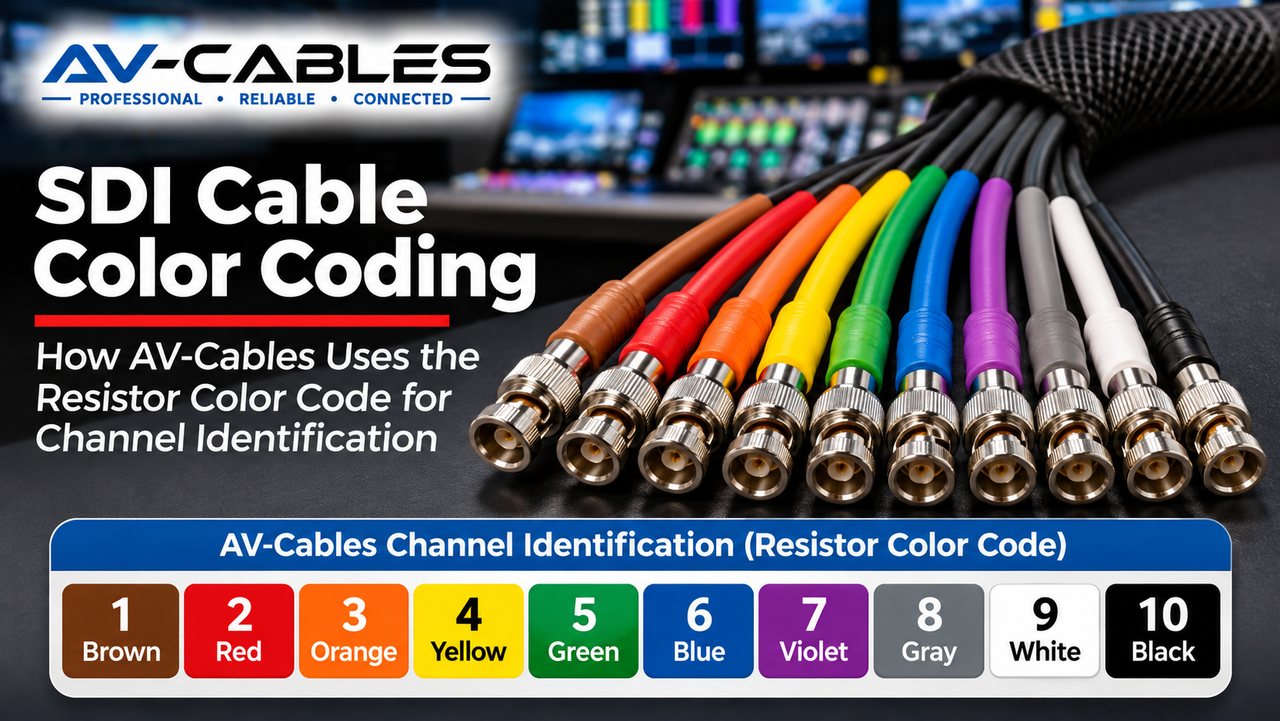
In a professional broadcast installation, dozens of SDI cables may connect cameras, video routers, production switchers, monitors, and recording equipment. When every cable looks identical, identifying individual connections can become time-consuming.
Color-coded SDI cables provide a practical way to organize broadcast video connections, simplify troubleshooting, and improve installation efficiency.
At AV-Cables, we take cable identification a step further. For our custom multi-channel cable assemblies, we use the familiar electronic resistor color code to identify individual channels.
This consistent approach makes our custom SDI snake cables easier to install, identify, and maintain.
Why Color Coding Matters in Broadcast Installations
Broadcast systems frequently contain multiple SDI signal paths. A single equipment rack may include camera feeds, program outputs, monitoring connections, and recording signals.
Without a consistent identification system, technicians may need to trace individual cables to determine their source and destination.
Color coding helps simplify that process.
Benefits of Color-Coded SDI Cables
- Faster identification of individual cable channels
- More organized broadcast equipment racks
- Easier camera and video router connections
- Reduced risk of connecting the wrong channel
- Simplified troubleshooting and maintenance
- Consistent identification across multi-channel cable assemblies
- Improved efficiency during installation and setup
How AV-Cables Uses the Resistor Color Code
The electronic resistor color code has been used for decades to represent numerical values through standardized colors.
AV-Cables applies this familiar numbering convention to channel identification in our custom multi-channel cable assemblies.
Our channel identification begins with Brown for Channel 1, followed by Red for Channel 2, Orange for Channel 3, and continuing through White for Channel 9.
Black represents Channel 10 in our cable identification system, corresponding to the zero digit in the standard resistor color code.
AV-Cables Channel Color Identification Chart
| Channel | Color | Resistor Code Digit |
|---|---|---|
| 1 | Brown | 1 |
| 2 | Red | 2 |
| 3 | Orange | 3 |
| 4 | Yellow | 4 |
| 5 | Green | 5 |
| 6 | Blue | 6 |
| 7 | Violet | 7 |
| 8 | Gray | 8 |
| 9 | White | 9 |
| 10 | Black | 0 |
By following this established color sequence, technicians familiar with electronic resistor identification can quickly recognize individual channels without relying exclusively on printed numbering.
Color Coding Custom SDI Snake Cables
Multi-channel SDI snake cables combine several coaxial signal paths into one organized assembly.
These cables are commonly used in broadcast studios, mobile production systems, live events, corporate AV installations, and professional video equipment racks.
When multiple channels exit a single cable assembly, clear channel identification becomes especially important.
At AV-Cables, our resistor-based color identification system provides a consistent method for recognizing individual channels at the breakout ends of custom cable snakes.
For example, a six-channel SDI snake uses the following identification:
- Channel 1 - Brown
- Channel 2 - Red
- Channel 3 - Orange
- Channel 4 - Yellow
- Channel 5 - Green
- Channel 6 - Blue
This allows technicians to match the corresponding channels at both ends of the assembly during installation.
Explore AV-Cables Custom SDI Snake Cables
Color Coding vs. Traditional Cable Labeling
Traditional cable labeling identifies individual connections using printed numbers, equipment names, or source and destination information.
Color coding adds another layer of identification.
Rather than replacing labels entirely, a consistent color identification system can complement them.
For example, a technician can quickly recognize a green channel breakout as Channel 5 while a printed label identifies the equipment connection.
Using both identification methods can make complex installations easier to understand and service.
Does Cable Color Affect SDI Signal Performance?
No. Cable jacket color or channel identification color does not determine SDI signal performance.
Professional SDI transmission depends on factors such as:
- Coaxial cable construction
- Signal attenuation
- 75-ohm impedance control
- Connector performance
- Cable assembly quality
- Transmission distance
- Required SDI data rate
For example, a properly designed 12G-SDI assembly using Belden 4855R Mini RG59 cable can support compatible 12G-SDI applications regardless of the color used to identify the channel.
Explore Belden 4855R 12G-SDI BNC Cables
Why Consistent Channel Identification Matters
In a professional broadcast environment, even a small connection mistake can interrupt a video signal or complicate troubleshooting.
Consistent channel identification helps reduce confusion when connecting multiple camera feeds, router inputs, monitoring outputs, and other signal paths.
A recognizable color sequence also helps technicians work with custom cable assemblies across different projects.
Applications That Benefit From Color-Coded Channels
- Multi-camera production systems
- Broadcast equipment racks
- Mobile production trucks
- Live event video systems
- Corporate AV installations
- Custom multi-channel SDI snakes
- Temporary and permanent video installations
Best Practices for Broadcast Cable Identification
- Use a consistent channel numbering system
- Identify corresponding channels at both ends
- Document the channel color sequence
- Use additional labels when equipment identification is needed
- Maintain proper cable routing and strain relief
- Choose SDI-rated cable assemblies for the intended signal format
- Verify connections before placing the system into production
Frequently Asked Questions
What color is Channel 1 on an AV-Cables snake?
Channel 1 is Brown, following the standard electronic resistor color code.
What color is Channel 5?
Channel 5 is Green.
What color is Channel 10?
AV-Cables uses Black for Channel 10, corresponding to digit zero in the standard resistor color code.
Why use resistor colors for cable channels?
The resistor color code provides a familiar and consistent numerical identification system that can help technicians recognize individual channels quickly.
Does color coding replace cable testing?
No. Color coding helps identify channels, but each cable assembly must still be properly manufactured and tested for its intended application.
Professional Cable Assemblies Designed for Easier Installation
At AV-Cables, we believe professional connectivity should be reliable, organized, and easy to maintain.
Our use of resistor color coding for custom multi-channel cable identification is one example of how thoughtful manufacturing details can help technicians in the field.
Whether you're building a broadcast studio, upgrading a video rack, or deploying a multi-camera production system, clearly identified cable assemblies can simplify installation and maintenance.
Custom SDI Snake Cables From AV-Cables
AV-Cables manufactures professional 6G-SDI and 12G-SDI multi-channel cable assemblies with custom lengths, connector configurations, breakout options, and resistor color-coded channel identification.
Our cable assemblies are hand-built and individually tested in the USA.
Professional Cable Manufacturing Since 1995.
AV-CABLES — PROFESSIONAL • RELIABLE • CONNECTED