
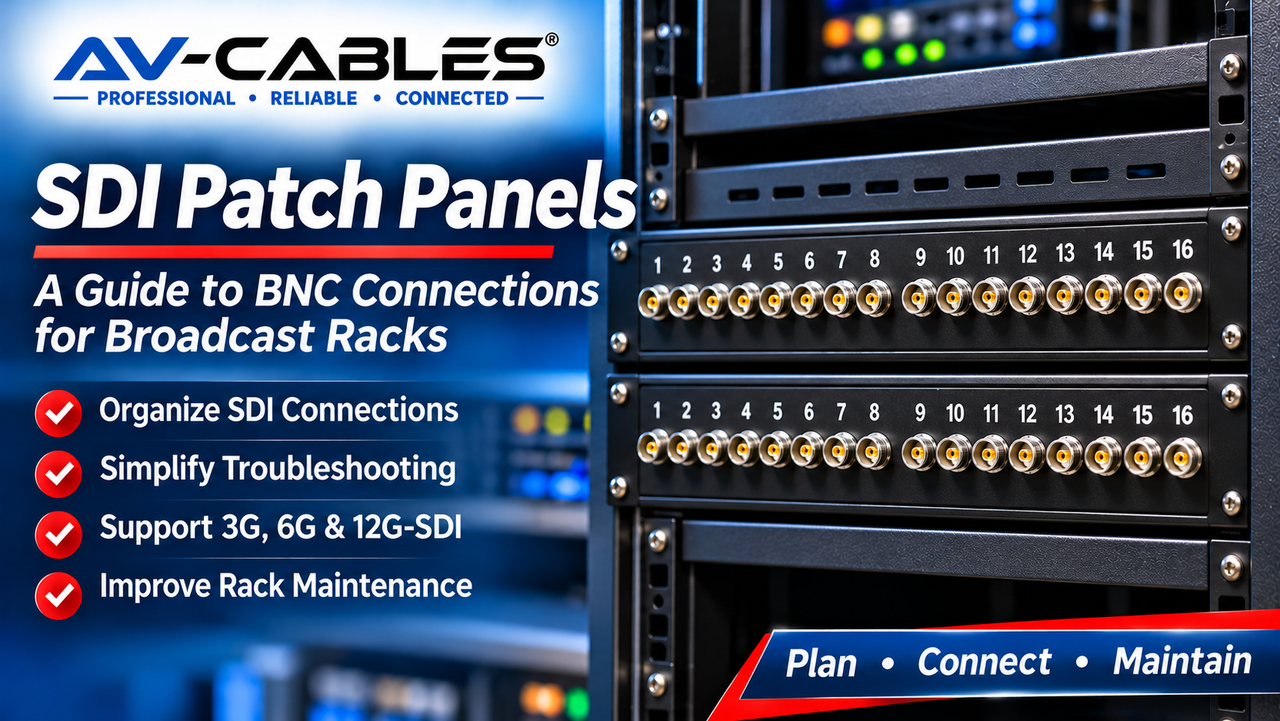
A well-designed broadcast equipment rack does more than hold video equipment. It provides an organized way to connect, identify, maintain, and troubleshoot signal paths.
One important component in many professional video installations is the SDI patch panel. By bringing connections to an accessible location, patch panels can make equipment changes and routine maintenance easier.
However, choosing the right patch panel, BNC connectors, and coaxial cable assemblies is essential, especially when working with higher-bandwidth formats such as 6G-SDI and 12G-SDI.
What Is an SDI Patch Panel?
An SDI patch panel is a connection point used to organize coaxial video signal paths in a broadcast or professional AV system.
Instead of connecting every cable directly between equipment located throughout a rack, installers can terminate selected connections at a centrally accessible panel.
Depending on the installation, a patch panel may use BNC, HD-BNC, or other compatible coaxial connector formats.
Patch panels are commonly found in television studios, production trucks, broadcast control rooms, video routing systems, and corporate AV installations.
Why Use an SDI Patch Panel?
Professional video systems often require frequent equipment changes, troubleshooting, or signal rerouting.
An organized patch panel can provide several advantages:
- Centralized access to video connections
- Easier equipment replacement and maintenance
- Reduced need to access rear equipment connections
- More consistent cable identification
- Improved rack organization
- Simplified temporary signal rerouting
- More efficient troubleshooting
A patch panel does not automatically improve signal quality. Its primary value is accessibility, organization, and operational flexibility.
Choosing BNC Connections for SDI Patch Panels
BNC connectors are widely used in professional SDI video systems because they provide a secure bayonet-style connection and are available in 75-ohm configurations designed for digital video transmission.
When selecting a patch panel, confirm that the connectors and complete signal path support the intended SDI format.
A connector that physically accepts a BNC cable is not necessarily qualified for every SDI data rate.
3G-SDI, 6G-SDI, and 12G-SDI
Higher SDI data rates generally place greater demands on cable attenuation, return loss, connector quality, and installation practices.
For 12G-SDI applications, use patch panels, feedthrough connectors, and cable assemblies specified for the required performance.
A 75-ohm BNC connector alone does not guarantee that an entire connection path will meet 12G-SDI requirements.
BNC vs. HD-BNC for Broadcast Racks
Traditional BNC connectors remain common throughout professional broadcast installations.
HD-BNC connectors offer a smaller physical footprint and can support higher connector density on compatible equipment and panels.
However, HD-BNC and standard BNC are different physical interfaces and cannot connect directly without an appropriate cable assembly or adapter.
When selecting between them, consider equipment compatibility, connector density, cable routing, service accessibility, and the required SDI performance.
Explore Professional HD-BNC Cable Assemblies
Choosing the Right Coaxial Cable for Rack Wiring
Cable selection is an important part of SDI patch panel design.
Different coaxial cable constructions offer different combinations of flexibility, physical size, attenuation, and practical transmission distance.
Mini RG59 for Dense Rack Installations
Mini RG59 cable constructions such as Belden 4855R can be useful where compact cable routing and reduced cable bulk are important.
These cables are particularly attractive for short equipment interconnections and dense patching environments when the complete assembly meets the required SDI performance.
View AV-Cables 12G-SDI Belden 4855R BNC Cables
RG59 and RG6 for Longer Cable Runs
For longer distances, larger coaxial cable constructions may offer lower attenuation than miniature cables of similar design quality.
However, larger cables also require more rack space and may have greater minimum bend-radius requirements.
Cable selection should be based on the required SDI data rate, total signal-path length, manufacturer performance data, and installation conditions.
Understanding Signal Loss Through Patch Panels
Every component in an SDI transmission path contributes to overall signal performance.
A typical signal path may include:
- Video source output
- SDI cable assembly
- Patch panel connector or feedthrough
- Patch cable
- Additional cable or routing connections
- Receiving equipment input
Cable attenuation, connector insertion loss, impedance discontinuities, and return loss can all affect the available signal margin.
For reliable operation, evaluate the complete signal path rather than considering cable length alone.
This is especially important when operating near the practical distance limits of a particular SDI cable construction.
Best Practices for SDI Patch Panel Installation
1. Keep Patch Cables Appropriately Sized
Use cable lengths that provide enough slack for service without creating unnecessary loops or excessive cable congestion.
2. Maintain Proper Bend Radius
Avoid sharp bends, crushed coaxial cable, and excessive tension near connectors. Follow the cable manufacturer's minimum bend-radius specifications.
3. Support Cable Weight
Use appropriate cable management and strain relief so that heavy cable bundles do not place unnecessary mechanical stress on connectors or equipment ports.
4. Label Both Ends
Identify the source and destination of each connection. Consistent labeling makes future maintenance and troubleshooting easier.
5. Verify Connector Compatibility
Confirm connector type, impedance, mechanical fit, and performance rating before installation.
6. Test the Completed Signal Path
Where appropriate, verify the installed signal path using equipment and test procedures suitable for the required SDI format.
When Custom SDI Cable Assemblies Make Sense
Standard cable lengths do not always provide the best fit for broadcast equipment racks.
Custom-length SDI cable assemblies can help reduce excess cable bulk while providing appropriate routing flexibility.
Custom configurations may also be useful when connecting equipment with different connector interfaces, including BNC and HD-BNC.
For installations requiring multiple signal paths between equipment locations, custom multi-channel cable assemblies may offer an organized alternative to routing numerous individual cables.
Explore Custom Multi-Channel SDI Snake Cables
Frequently Asked Questions
Can any BNC patch panel carry 12G-SDI?
No. The patch panel and its connectors must provide suitable electrical performance for 12G-SDI. Physical connector compatibility alone is not sufficient.
Does an SDI patch panel increase cable distance?
No. A passive patch panel does not regenerate or amplify the SDI signal. Additional connections can introduce loss and reflections that must be considered in the overall signal budget.
Is Mini RG59 suitable for broadcast racks?
Yes, when the selected Mini RG59 cable assembly supports the required signal format and distance. Its compact construction can be beneficial in crowded racks.
Should I use BNC or HD-BNC?
Choose the connector interface required by your equipment and patch panel. HD-BNC can provide higher connection density, while standard BNC remains widely used in professional video systems.
Build a More Organized Broadcast Rack
A well-planned SDI patch panel installation can make broadcast systems easier to service, expand, and troubleshoot.
Choosing compatible connectors, suitable coaxial cable assemblies, appropriate cable lengths, and consistent labeling practices helps create a more maintainable installation.
Professional SDI Cable Assemblies From AV-Cables
AV-Cables manufactures professional broadcast cable assemblies for 3G-SDI, 6G-SDI, and 12G-SDI applications, including BNC, HD-BNC, and custom multi-channel configurations.
We offer custom lengths and connector configurations to support equipment racks, production systems, and professional AV installations.
Our cable assemblies are hand-built and individually tested in the USA.
Professional Cable Manufacturing Since 1995.
AV-CABLES — PROFESSIONAL • RELIABLE • CONNECTED