
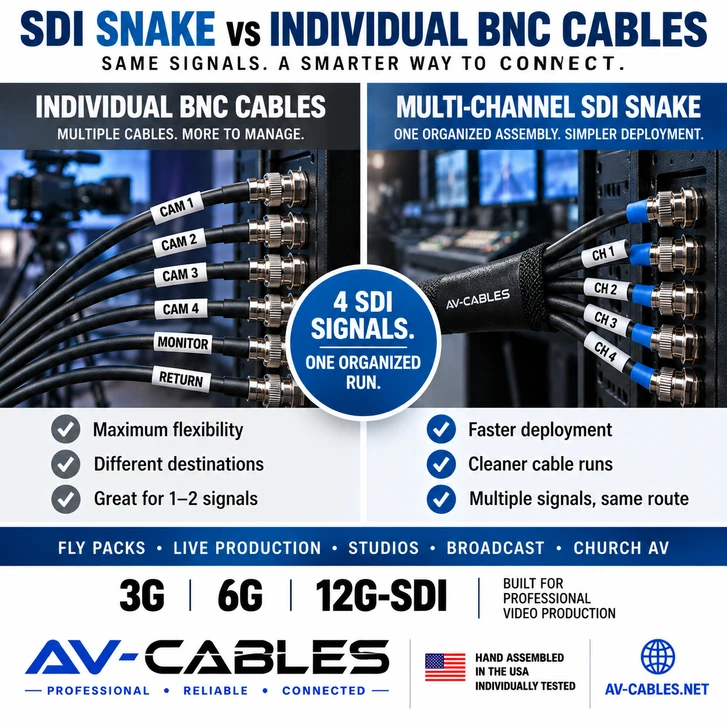
A multi-camera production can quickly turn into a pile of individual BNC cables.
Four cameras may require four SDI feeds. Add return video, reference, monitoring or additional signal paths and suddenly a production crew may be deploying, labeling and recovering a substantial number of separate coaxial cables.
One alternative is a multi-channel SDI snake cable: several professional video coax channels organized into a single assembly.
Neither approach is automatically right for every application. The better choice depends on the number of signals, deployment frequency, cable distance, equipment layout and how much flexibility the system requires.
Here is how SDI snake cables compare with running individual BNC cables.
WHAT IS AN SDI SNAKE CABLE?
An SDI snake combines multiple coaxial video channels into one organized cable assembly.
Each channel remains an individual 75-ohm signal path with its own connectors, but the channels are bundled together for much of the cable run.
Depending on the application, an assembly might contain:
- Multiple BNC-to-BNC SDI channels
- 12G-SDI coax channels
- SDI plus Ethernet
- Video and other production connectivity
- Custom channel configurations
The objective is not to combine multiple SDI signals electrically. Each signal still travels on its own coaxial channel.
The snake simply organizes those channels into a more manageable physical assembly.
OPTION 1: INDIVIDUAL BNC CABLES
Individual SDI BNC cables provide maximum flexibility.
Each cable can be:
- Routed independently
- Replaced independently
- Used at a different length
- Connected to equipment in different locations
- Reassigned as production requirements change
If Camera 1 is 25 feet away and Camera 2 is 100 feet away, separate cables make it easy to choose exactly the required length for each path.
For small systems with only one or two signals, individual cables are often the simplest solution.
OPTION 2: MULTI-CHANNEL SDI SNAKE
An SDI snake becomes particularly useful when several signals repeatedly travel between the same two general locations.
For example:
Stage → Production Position
Camera Platform → Fly Pack
Equipment Rack A → Equipment Rack B
Machine Room → Studio
Instead of deploying four, five or more completely separate cables along the same path, the crew can deploy one organized multi-channel assembly.
ADVANTAGE #1: FASTER DEPLOYMENT
Live production often involves repeatedly installing and removing the same signal paths.
If six individual cables must travel from a stage to a production position, each cable needs to be deployed and organized.
A six-channel snake consolidates much of that work into one primary cable run.
The fan-out at each end then provides access to the individual channels.
This can make setup and teardown more organized, particularly for touring, corporate events, houses of worship and portable production systems.
ADVANTAGE #2: CLEANER CABLE PATHS
Running multiple loose BNC cables along exactly the same route can create a cluttered installation.
A properly designed snake keeps the channels grouped together through the main cable path.
This can simplify:
- Cable trays
- Floor runs
- Rack-to-rack connections
- Fly pack wiring
- Production cases
- Temporary event installations
At each end, the individual channel fan-outs provide enough separation to reach the required equipment connections.
ADVANTAGE #3: EASIER CHANNEL IDENTIFICATION
When several identical black BNC cables arrive at a production rack, identifying the correct signal can become unnecessarily difficult.
Multi-channel snakes can use clearly identified channels so the operator knows which connector corresponds to each signal path.
For example:
CH 1 — Camera 1
CH 2 — Camera 2
CH 3 — Camera 3
CH 4 — Camera 4
Good labeling becomes even more valuable when troubleshooting during a live event.
ADVANTAGE #4: BETTER FOR REPEATED PRODUCTION WORKFLOWS
Snakes make the most sense when the same group of connections repeatedly travels together.
A production company might always need four SDI channels between its camera area and switcher position.
A fly pack might consistently require several video connections between two equipment cases.
A house of worship might have a recurring production position that needs multiple SDI feeds from the same stage area.
These predictable workflows are excellent candidates for multi-channel assemblies.
WHEN INDIVIDUAL BNC CABLES ARE BETTER
A snake is not always the better solution.
Individual cables make more sense when the signal destinations are widely separated.
Imagine four cameras positioned in four different corners of a venue.
If every camera follows a completely different cable route, bundling all four channels into one snake provides little benefit.
Individual cables also provide greater flexibility when cable lengths frequently change from production to production.
12G-SDI SNAKE CABLES
UHD production adds another consideration: bandwidth.
A snake intended for 12G-SDI applications should use coaxial cable and connectors appropriate for the required 12G-SDI transmission path.
The same distance considerations that apply to an individual 12G cable also apply to each channel within a snake.
The fact that several channels are physically grouped together does not eliminate the transmission-distance limitations of the coax.
Read our 12G-SDI cable distance guide when planning longer UHD runs.
SDI + ETHERNET HYBRID SNAKES
Not every production pathway requires only video.
Modern production systems frequently need SDI and network connectivity traveling between the same locations.
A hybrid assembly can combine multiple dedicated cable types into one organized harness.
For example, a production system might require:
- SDI video feeds
- Ethernet control
- Network connectivity
- Additional return-video paths
AV-Cables can manufacture configurations that combine professional SDI coax with EtherCON tactical connectivity when both signal types need to follow the same physical route.
FLY PACKS ARE AN IDEAL SNAKE APPLICATION
Portable fly packs are designed around fast deployment.
The production rack may contain a switcher, router, converters, monitors, recording equipment and network hardware.
Rather than making numerous independent connections every time the system is deployed, purpose-built snakes can create predictable groups of connections between cases or production positions.
That can make both setup and troubleshooting easier.
PERMANENT INSTALLATIONS CAN BENEFIT TOO
Snakes are not limited to portable production.
Permanent installations may have several signal paths traveling between the same racks, rooms or equipment locations.
Applications can include:
- Broadcast studios
- Control rooms
- Houses of worship
- Corporate AV facilities
- Auditoriums
- Educational production facilities
A custom multi-channel assembly can simplify the physical cable pathway while still providing individually accessible connections at each end.
DON'T FORGET THE FAN-OUT LENGTH
When specifying a custom snake, the overall length is only part of the design.
The individual channels must separate from the main bundle far enough from the end to comfortably reach their equipment connectors.
If the connectors on a rack are spread across several devices, a very short fan-out can make installation difficult.
Think about:
- Where the main bundle will be secured
- Where each channel terminates
- How far apart the equipment connectors are
- Whether service loops are required
- How the snake will enter the rack or case
A custom assembly should be designed around the actual installation rather than simply choosing an overall length.
SNAKE CABLE VS INDIVIDUAL CABLES: QUICK COMPARISON
| Application | Individual BNC | SDI Snake |
|---|---|---|
| 1–2 signals | Excellent | Usually unnecessary |
| Several signals following same route | Works | Excellent |
| Widely separated destinations | Excellent | Less practical |
| Repeated setup / teardown | Good | Excellent |
| Fly pack | Good | Excellent |
| Maximum routing flexibility | Excellent | Application dependent |
HOW TO SPECIFY AN SDI SNAKE
Before ordering a multi-channel assembly, determine:
- Number of channels
- Required SDI format — 3G, 6G or 12G
- Overall cable length
- Connector type at each end
- Required fan-out lengths
- Whether Ethernet or other connectivity is needed
- How the assembly will be deployed and stored
These details allow the assembly to be designed around the actual production workflow.
THE BOTTOM LINE
If only one or two SDI signals are required—or the signals travel in completely different directions—individual BNC cables usually provide the greatest flexibility.
When several SDI signals repeatedly travel between the same locations, however, a multi-channel SDI snake can provide a cleaner and more organized production workflow.
For fly packs, production companies, studios, houses of worship and portable video systems, reducing a group of loose cables to one organized assembly can simplify deployment without changing the fundamental 75-ohm signal paths.
CUSTOM BROADCAST SNAKE CABLES FROM AV-CABLES
AV-Cables manufactures professional broadcast snake cable assemblies for live production, broadcast facilities, studios, fly packs, corporate AV, houses of worship, government, OEM and systems integration applications.
Configurations can include multiple SDI channels as well as hybrid assemblies combining SDI and Ethernet connectivity.
AV-Cables professional cable assemblies are hand assembled in the USA and individually tested before shipment.
NEED A CUSTOM SDI SNAKE?
Tell us the number of channels, required SDI format, overall length, connector types and desired fan-out lengths. AV-Cables can help build an assembly around your production workflow.
AV-Cables — Professional Broadcast Connectivity Solutions