
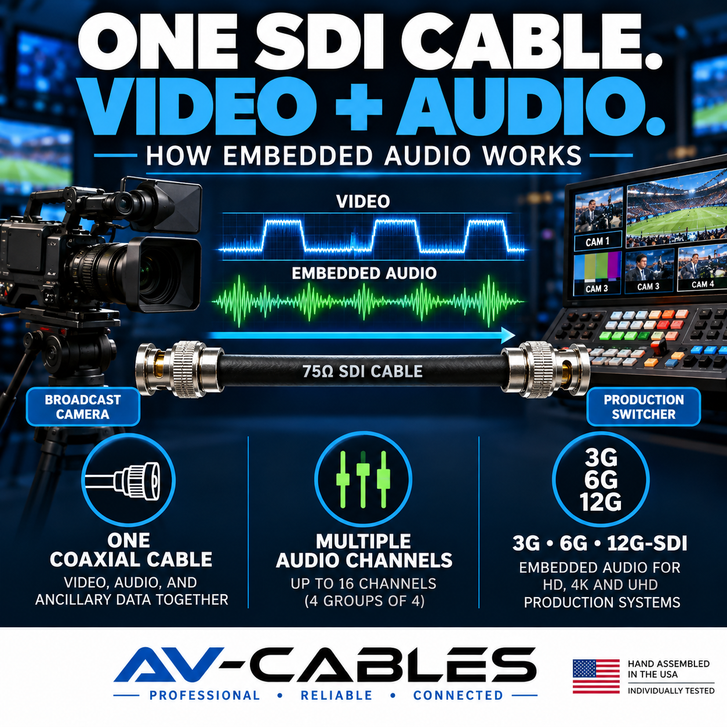
When connecting professional broadcast cameras, video switchers, recorders, and monitors, you may notice that only one BNC cable is needed to transport the video signal.
But what about the audio?
Do you need a separate XLR cable, or can the SDI connection carry both video and audio?
Yes. SDI can carry digital audio embedded within the video signal, allowing video and multiple audio channels to travel together over a single 75-ohm coaxial cable.
This capability is widely used in television broadcasting, live production, recording studios, sports production, houses of worship, and professional AV installations.
Understanding how SDI embedded audio works can help you simplify cabling, troubleshoot missing audio, and choose the correct connections for your equipment.
WHAT IS SDI EMBEDDED AUDIO?
SDI embedded audio refers to digital audio information carried within a serial digital video signal.
Instead of transmitting video and audio over completely separate cables, compatible broadcast equipment combines them into one digital signal.
The audio information is transported in designated ancillary data areas of the SDI signal.
This allows a single SDI connection to carry:
- Digital video
- Multiple channels of embedded digital audio
- Supported ancillary data and metadata
All of this information travels through the same SDI transmission path.
THE SIMPLE EXPLANATION
A professional SDI cable can transport both video and embedded audio between compatible devices.
The equipment creates, inserts, extracts, and processes the audio information. The cable provides the physical connection that carries the complete SDI signal.
HOW DOES AUDIO TRAVEL THROUGH AN SDI CABLE?
An SDI signal contains more than the active picture information displayed on a monitor.
It also provides designated space for ancillary data.
Embedded digital audio is transported in this ancillary data space using defined packet structures.
At the transmitting equipment, audio data is incorporated into the SDI stream.
The complete signal then travels through the coaxial cable to the receiving equipment.
A compatible receiver can recover the video and access the embedded audio channels.
This is one reason SDI remains useful in professional broadcast production: one cable can carry multiple types of information needed by the production system.
AV-Cables manufactures professional 75-ohm SDI BNC cable assemblies for cameras, switchers, routers, recorders, and other broadcast equipment.
HOW MANY AUDIO CHANNELS CAN SDI CARRY?
Many professional HD-SDI, 3G-SDI, 6G-SDI, and 12G-SDI workflows support up to 16 channels of embedded digital audio.
These channels are commonly organized into four groups containing four channels each.
For example:
| Audio Group | Channel Numbers | Number of Channels |
|---|---|---|
| Group 1 | 1–4 | 4 |
| Group 2 | 5–8 | 4 |
| Group 3 | 9–12 | 4 |
| Group 4 | 13–16 | 4 |
In a typical production environment, these channels might be assigned to program audio, camera microphones, natural sound, or additional production audio sources.
However, the number of supported channels depends on the SDI format, applicable standards, and the capabilities of the connected equipment.
Some SDI standards provide additional audio-channel capacity, but not every device supports every available channel configuration.
Important: A cable rated for 12G-SDI does not automatically mean that the connected equipment supports 16 embedded audio channels. Audio capabilities are determined by the devices and their supported formats.
DOES 12G-SDI CARRY AUDIO?
Yes. Compatible 12G-SDI equipment can transport embedded audio along with high-bandwidth digital video.
This is particularly useful in professional 4K UHD production systems.
For example, a 12G-SDI camera may send its video signal and embedded audio to a production switcher using one coaxial connection.
The switcher may then route, process, or replace audio depending on its capabilities and configuration.
For compact 12G-SDI installations, AV-Cables offers Belden 4855R Mini RG59 12G-SDI BNC cable assemblies.
These professional 75-ohm assemblies are designed for compatible 12G-SDI equipment used in broadcast studios, production trucks, fly packs, and video equipment racks.
DOES 3G-SDI AND 6G-SDI CARRY AUDIO?
Yes. Compatible 3G-SDI and 6G-SDI equipment can also transport embedded audio.
The basic concept remains the same: digital audio information is carried within the SDI stream.
However, different equipment may support different audio-channel counts, formats, and routing options.
Always verify the audio capabilities of the camera, switcher, recorder, converter, or other device being connected.
AV-Cables offers professional 6G-SDI BNC cable assemblies for compatible HD and UHD video applications.
WHAT IS AN SDI AUDIO EMBEDDER?
An SDI audio embedder is an electronic device that inserts digital audio into an SDI video stream.
For example, a production system may have:
- An SDI video signal from a camera
- Digital audio from an audio console
- A recorder that needs video and audio together
An audio embedder can combine the supported audio channels with the SDI signal before sending it to the recorder.
Depending on the equipment, the audio source may use AES/EBU, analog audio, or another supported interface.
EXAMPLE: EMBEDDING AUDIO INTO SDI
Camera SDI Video → Audio Embedder
Audio Console Output → Audio Embedder
↓
SDI Output With Embedded Audio
↓
Professional Video Recorder
Some production switchers, converters, and other broadcast devices include audio embedding functions internally, eliminating the need for a separate external embedder.
WHAT IS AN SDI AUDIO DE-EMBEDDER?
An SDI audio de-embedder performs the opposite function.
It extracts audio information from an incoming SDI stream and makes that audio available through supported output connections.
For example, a video signal containing embedded audio may arrive at a broadcast control room.
A de-embedder can extract selected audio channels for use by an audio console, monitoring system, or recording device.
Depending on the equipment, extracted audio may be available through AES/EBU, analog, or other supported interfaces.
Some professional converters can both embed and de-embed audio.
SDI EMBEDDED AUDIO VS. AES/EBU DIGITAL AUDIO
SDI embedded audio and AES/EBU are both used in professional broadcast systems, but they serve different connection requirements.
SDI is primarily a digital video interface that can also transport embedded audio.
AES/EBU, commonly referring to the AES3 digital audio interface, provides a dedicated digital audio connection.
One common professional AES3 implementation uses balanced 110-ohm cable with 3-pin XLR connectors.
| Feature | SDI Embedded Audio | Balanced AES/EBU (AES3) |
|---|---|---|
| Primary Application | Video with embedded audio | Dedicated digital audio |
| Typical Cable | 75-ohm coaxial | 110-ohm balanced twisted pair |
| Typical Connector | BNC, HD-BNC, or DIN 1.0/2.3 | 3-pin XLR |
| Video Transport | Yes | No |
| Audio Transport | Yes, when embedded | Yes |
| Common Use | Cameras, switchers, recorders, routers | Digital consoles, processors, audio interfaces |
Both interfaces are useful in professional production environments.
For dedicated digital audio connections, AV-Cables manufactures 110-ohm AES/EBU digital audio cables using Canare and Mogami cable with professional Neutrik XLR connectors.
These assemblies are available in standard and custom lengths for broadcast, recording, and live production applications.
DOES EVERY SDI DEVICE PASS EMBEDDED AUDIO?
Not necessarily.
Although SDI supports embedded audio, individual devices may process or handle that audio differently.
Some equipment passes embedded audio through without modification.
Other devices may:
- Extract selected audio channels
- Replace existing audio channels
- Change audio channel assignments
- Mute or remove audio
- Support only certain audio groups
- Require audio routing to be enabled
Video converters and production switchers may also have settings that determine whether embedded audio is passed through or replaced.
Before installing a system, confirm that every device in the signal path supports the required audio configuration.
WHY DOES MY SDI VIDEO WORK BUT THE AUDIO IS MISSING?
One common troubleshooting situation occurs when the SDI video picture is present but the expected audio cannot be heard or recorded.
If the video signal is operating normally, the problem may involve audio configuration rather than the coaxial cable itself.
Possible causes include:
1. The Source Is Not Embedding Audio
The camera or other transmitting device may not be configured to include audio in its SDI output.
2. Incorrect Audio Channel Selection
The receiving equipment may be monitoring channels 1 and 2 while the audio is actually assigned to another channel pair.
3. Audio Is Muted
The source, switcher, recorder, or monitoring device may have audio muted or disabled.
4. A Converter Is Removing Audio
Some conversion or processing equipment may remove, replace, or fail to preserve particular embedded audio channels.
5. Unsupported Audio Configuration
The receiving equipment may not support the audio format or channel arrangement being transmitted.
6. Audio Routing Is Incorrect
A video switcher or router may be configured to use audio from a different source.
TROUBLESHOOTING TIP
If video is stable but audio is missing, verify the embedded audio settings and channel mapping at the source and destination before replacing the SDI cable.
CAN A BAD SDI CABLE AFFECT EMBEDDED AUDIO?
Yes.
Embedded audio is part of the transmitted SDI data stream.
If the coaxial transmission path becomes unreliable, the receiving equipment may experience problems recovering the transmitted data.
Depending on the equipment and severity of the signal problem, this may affect video, audio, or the overall connection.
Common cable-related concerns include:
- Excessive cable length
- Damaged coaxial cable
- Improper BNC connector termination
- Impedance discontinuities
- Excessive signal attenuation
- Unnecessary adapters or patch points
For demanding 6G-SDI and 12G-SDI applications, professional 75-ohm cable construction is important.
Learn more in our SDI signal dropout troubleshooting guide.
WHICH SDI CABLE SHOULD YOU USE FOR EMBEDDED AUDIO?
You do not need a special coaxial cable solely because your SDI signal contains embedded audio.
Instead, select a professional SDI cable assembly that supports the video format, transmission distance, and connector requirements of your equipment.
Belden 4855R — 12G-SDI Mini RG59
Belden 4855R provides a compact 75-ohm coaxial option for professional 12G-SDI applications.
Its smaller diameter is useful in high-density equipment racks, fly packs, and mobile production systems.
View Belden 4855R 12G-SDI cables.
Belden 4505R — 12G-SDI RG59
Belden 4505R provides a larger RG59 construction for professional 12G-SDI video connections.
It offers a different balance of cable size and attenuation compared with Mini RG59.
Explore 12G-SDI RG59 cable options.
Belden 4694R — 12G-SDI RG6
Belden 4694R is a professional RG6 coaxial option for longer 12G-SDI signal paths.
Its larger construction can provide lower attenuation than smaller coaxial cable types.
Compare professional 12G-SDI cables.
The correct cable should be selected based on the complete system, including the transmitter, receiver, cable length, connectors, and installation environment.
WHEN DO YOU STILL NEED SEPARATE AUDIO CABLES?
Even though SDI can carry embedded audio, separate audio connections remain important in professional production systems.
Examples include:
- Microphone connections to audio consoles
- Digital AES/EBU connections between audio equipment
- Audio feeds that must be processed independently
- Connections to equipment without SDI audio extraction
- Dedicated audio routing and monitoring systems
Some installations use SDI for camera video and embedded audio while also using separate XLR or AES/EBU connections for additional production audio requirements.
AV-Cables manufactures professional XLR microphone cables and AES/EBU digital audio cables for these applications.
SDI EMBEDDED AUDIO IN LIVE PRODUCTION
Embedded audio is useful in many professional broadcast environments.
Broadcast Television
Cameras, video routers, production switchers, and recorders can exchange video with associated audio through SDI connections.
Sports Production
Camera feeds may include natural sound or other audio sources that need to reach production equipment along with the video.
Houses of Worship
Embedded audio can simplify connections between production switchers, recording systems, and streaming equipment.
Mobile Production Trucks
Combining video and associated audio in SDI connections can reduce the need for separate audio cables between compatible devices.
Corporate AV
Professional SDI systems may transport video and audio together between compatible presentation, recording, and processing equipment.
WHAT ABOUT MULTI-CHANNEL SDI SNAKE CABLES?
Multi-channel SDI snake cables organize several independent coaxial connections into one cable assembly.
Each coaxial channel can transport its own SDI signal, including embedded audio when provided by the connected equipment.
For example, a five-channel SDI snake could connect five independent camera outputs to a production rack.
Each channel remains a separate SDI transmission path.
The snake cable does not combine the five video signals into one SDI stream or automatically mix their embedded audio.
AV-Cables manufactures custom SDI snake cables and broadcast cable looms for professional production applications.
SDI EMBEDDED AUDIO TROUBLESHOOTING CHECKLIST
If embedded audio is missing or unreliable:
- Confirm the source is configured to embed audio.
- Check which audio channels are active.
- Verify audio routing at the receiving device.
- Check for muted or disabled audio channels.
- Confirm the equipment supports the required audio format.
- Review converter and switcher audio settings.
- Verify that the SDI video format is supported.
- Inspect the coaxial cable and connectors.
- Confirm the total cable length is within supported limits.
- Test the complete system with known audio content.
FREQUENTLY ASKED QUESTIONS
Does an SDI cable carry both video and audio?
Yes. A compatible SDI connection can carry digital video and embedded audio together over a single 75-ohm coaxial cable.
How many audio channels can 12G-SDI carry?
Many professional 12G-SDI devices support up to 16 embedded audio channels. The actual number depends on the equipment, video format, and supported audio configuration.
Does embedded audio require a special BNC cable?
No. Use a properly constructed SDI cable assembly rated for the required video data rate and transmission distance.
Can I extract audio from an SDI signal?
Yes. A compatible SDI audio de-embedder or other equipment with audio extraction capabilities can provide access to embedded audio channels.
Can I add audio to an SDI video signal?
Yes. An SDI audio embedder or compatible production equipment can insert supported audio channels into the SDI stream.
Is SDI embedded audio the same as AES/EBU?
No. SDI carries audio as part of a digital video stream. AES/EBU provides a dedicated professional digital audio interface. Equipment with embedding or de-embedding capabilities can transfer audio between supported interfaces.
Why does my SDI video work but audio does not?
Possible causes include missing embedded audio at the source, incorrect channel mapping, muted audio, unsupported formats, or equipment that removes or replaces audio during processing.
Can a 12G-SDI cable carry 3G-SDI video with embedded audio?
Yes. A properly constructed 12G-SDI cable can carry compatible lower-data-rate SDI formats. The connected equipment determines the video and embedded audio capabilities.
THE BOTTOM LINE
Professional SDI connections can carry more than digital video.
When supported by the transmitting and receiving equipment, a single SDI cable can transport video and multiple embedded audio channels together.
This simplifies cabling between cameras, switchers, routers, recorders, and other professional broadcast devices.
However, reliable operation still depends on compatible equipment, correct audio configuration, and a properly selected SDI cable assembly.
For professional 3G-SDI, 6G-SDI, and 12G-SDI systems, choose the appropriate 75-ohm coaxial cable and connectors for the complete transmission path.
PROFESSIONAL VIDEO AND AUDIO CABLES FROM AV-CABLES
AV-Cables manufactures professional broadcast cable assemblies for studios, live production, mobile trucks, houses of worship, and commercial AV installations.
Our product selection includes:
- 12G-SDI BNC cables
- 6G-SDI BNC cables
- Belden 4855R Mini RG59
- Belden 4505R RG59
- Belden 4694R RG6
- HD-BNC and DIN 1.0/2.3 connections
- 110-ohm AES/EBU digital audio cables
- Professional XLR microphone cables
- Custom multi-channel SDI snake cables
Hand assembled in the USA and individually tested.
Standard and custom lengths are available for professional production systems.
AV-Cables — Professional • Reliable • Connected