
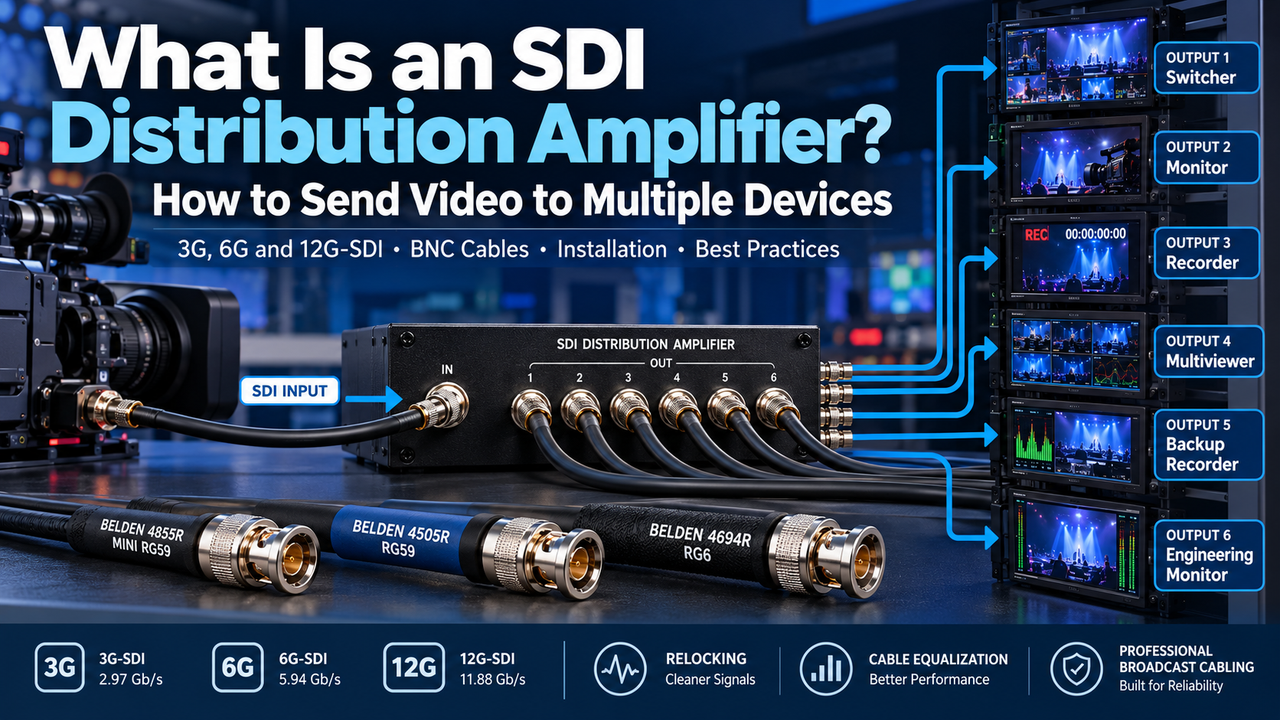
In professional broadcast production, one video signal often needs to reach several devices at the same time. A camera feed may need to appear on a production switcher, engineering monitor, recorder, multiviewer, and backup recording system.
But how do you send one SDI video signal to multiple destinations without compromising the connection?
The answer is an SDI distribution amplifier, commonly called an SDI DA.
This guide explains how SDI distribution amplifiers work, the differences between 3G, 6G, and 12G models, and how to select the correct 75-ohm BNC cable assemblies for your broadcast installation.
What Is an SDI Distribution Amplifier?
An SDI distribution amplifier is an electronic device that accepts one Serial Digital Interface video signal and distributes it to multiple independent outputs.
For example, a 1x6 SDI distribution amplifier has one SDI input and six separately driven SDI outputs.
Each output can connect to a compatible receiving device, allowing multiple pieces of broadcast equipment to receive the same video feed.
ONE VIDEO SOURCE → MULTIPLE VIDEO DESTINATIONS
An SDI distribution amplifier provides multiple copies of a compatible incoming video signal without requiring additional outputs from the original source.
How Does an SDI Distribution Amplifier Work?
A typical distribution amplifier receives an SDI signal through a professional 75-ohm coaxial cable.
Internal circuitry processes the signal and provides separately buffered outputs. Many professional models also include automatic cable equalization and reclocking.
BROADCAST CAMERA
↓
75-OHM SDI BNC CABLE
↓
1x6 SDI DISTRIBUTION AMPLIFIER
| OUTPUT 1 Switcher |
OUTPUT 2 Monitor |
OUTPUT 3 Recorder |
| OUTPUT 4 Multiviewer |
OUTPUT 5 Backup Recorder |
OUTPUT 6 Engineering Monitor |
In this example, seven SDI cable assemblies are required: one input cable and six output cables.
3G vs. 6G vs. 12G-SDI Distribution Amplifiers
Not every distribution amplifier supports the same video formats or data rates.
| SDI Format | Nominal Data Rate | Typical Application |
|---|---|---|
| 3G-SDI | 2.97 Gb/s | Compatible 1080p HD video |
| 6G-SDI | 5.94 Gb/s | Compatible UHD formats |
| 12G-SDI | 11.88 Gb/s | Compatible single-link 4K UHD video |
A professional 12G-SDI distribution amplifier can support compatible high-bandwidth video signals, but a 3G-only model should not be assumed to support 12G-SDI.
Always verify equipment specifications before installation.
What Is SDI Reclocking?
Reclocking helps regenerate the timing of an incoming digital SDI signal.
As a signal travels through coaxial cable, attenuation and transmission impairments can affect its quality.
A compatible reclocking circuit recovers the signal timing and generates a cleaner output, helping reduce accumulated timing jitter.
However, reclocking cannot recover every severely degraded signal. Proper cable selection and sufficient signal margin remain essential.
What Is SDI Cable Equalization?
Cable equalization compensates for certain frequency-dependent losses introduced by coaxial cable.
Higher-bandwidth signals such as 12G-SDI are particularly sensitive to attenuation.
Many professional distribution amplifiers combine cable equalization and reclocking to improve signal recovery.
These features do not eliminate the need for properly rated coaxial cable assemblies.
Can You Use a BNC T-Connector Instead?
A passive BNC T-connector is not a suitable replacement for a professional SDI distribution amplifier.
SDI systems use controlled-impedance 75-ohm transmission paths. Splitting a signal passively can introduce impedance mismatches, reflections, and signal integrity problems.
IMPORTANT: Use a distribution amplifier designed for the required SDI data rate rather than attempting to split professional SDI signals with ordinary passive BNC adapters.
SDI Distribution Amplifier vs. Video Router
An SDI distribution amplifier sends copies of one source to multiple destinations.
An SDI video router allows multiple input sources to be assigned to selected outputs.
Some routers also support sending one input to multiple outputs, but a dedicated distribution amplifier can provide a straightforward solution when the same video feed must reach several devices.
Choosing the Right SDI Cable for Your Distribution Amplifier
The correct cable depends on the required SDI format, transmission distance, equipment layout, and connector configuration.
Belden 4855R Mini RG59 — Compact Rack Connections
Belden 4855R is a professional 75-ohm Mini RG59 coaxial cable designed for 12G-SDI applications.
Its compact construction makes it useful for high-density equipment racks, video patching, and short distribution amplifier connections.
Shop Belden 4855R 12G-SDI BNC Cables
Belden 4505R RG59 — General Broadcast Connections
Belden 4505R provides a larger RG59 construction with lower attenuation than Mini RG59 over comparable lengths.
It is a practical option for connections between distribution amplifiers, routers, monitors, and other production equipment.
Shop Belden 4505R 12G-SDI RG59 Cables
Belden 4694R RG6 — Longer SDI Runs
Belden 4694R is a professional 12G-SDI RG6 coaxial cable designed for applications where lower attenuation is important.
Its larger construction can provide additional transmission margin for longer runs.
Shop Belden 4694R 12G-SDI RG6 Cables
Do You Need HD-BNC or DIN 1.0/2.3 Connections?
Although many SDI distribution amplifiers use standard BNC connectors, some professional broadcast equipment uses compact HD-BNC or DIN 1.0/2.3 interfaces.
Purpose-built cable assemblies can connect compatible equipment without unnecessary adapters.
- BNC to BNC
- BNC to HD-BNC
- BNC to DIN 1.0/2.3
- HD-BNC to HD-BNC
Explore Professional HD-BNC Cable Assemblies
Does an SDI Distribution Amplifier Extend Cable Distance?
A professional distribution amplifier can regenerate a compatible incoming signal and provide new output transmission paths.
However, each cable segment must remain within the supported capabilities of the equipment and cable construction.
The incoming signal must reach the amplifier with sufficient quality for recovery, and each output must reach its receiving device reliably.
For very long distances, optical transmission or purpose-built SDI extension equipment may be more appropriate.
Common SDI Distribution Troubleshooting Problems
1. Unsupported Video Format
Confirm the amplifier supports the incoming SDI data rate and format.
2. Incorrect Cable Construction
A cable suitable for HD-SDI may not provide adequate performance for 12G-SDI.
3. Excessive Cable Length
Check the complete signal path, including patch panels and adapters.
4. Damaged BNC Connectors
Inspect connectors for physical damage, poor engagement, or unreliable termination.
5. Equipment Power or Configuration
Verify the distribution amplifier is powered and operating correctly.
6. Receiver Compatibility
Confirm that every connected monitor, recorder, or other destination supports the distributed SDI format.
Frequently Asked Questions
Can one camera feed six monitors?
Yes. A compatible 1x6 SDI distribution amplifier can send one camera signal to six independent destinations.
Does an SDI distribution amplifier convert 3G-SDI to 12G-SDI?
No. A standard distribution amplifier copies the incoming signal. Format conversion requires compatible conversion equipment.
Does an SDI distribution amplifier preserve embedded audio?
Many professional models preserve embedded audio and ancillary data. Verify the specifications of the selected equipment.
Do all output cables need to be the same length?
No. Each output can use a different cable length or construction, provided the individual signal path meets the required specifications.
What is the best cable for a 12G-SDI distribution amplifier?
Belden 4855R is useful for compact rack connections. Belden 4505R and 4694R offer lower attenuation for longer cable runs.
Can a distribution amplifier repair a damaged SDI signal?
Equalization and reclocking can help recover a compatible incoming signal, but they cannot guarantee recovery of severely degraded signals or correct every cable fault.
The Bottom Line
SDI distribution amplifiers allow professional video systems to send one source to multiple destinations.
They are commonly used in television studios, production trucks, live events, sports facilities, and commercial AV installations.
Reliable operation requires compatible distribution equipment and properly constructed 75-ohm coaxial cable assemblies.
Choosing the correct SDI cable, connector configuration, and transmission distance helps create an organized and dependable broadcast installation.
Professional Broadcast Cabling from AV-Cables
AV-Cables manufactures professional SDI cable assemblies for broadcast cameras, distribution amplifiers, switchers, routers, monitors, and production systems.
- Belden 4855R 12G-SDI Mini RG59
- Belden 1855A 6G-SDI Mini RG59
- Belden 4505R 12G-SDI RG59
- Belden 4694R 12G-SDI RG6
- Precision 75-ohm BNC connectors
- HD-BNC and DIN 1.0/2.3 assemblies
- Custom multi-channel SDI cable looms
Hand assembled in the USA and individually tested.
Need a complete set of SDI cables for a distribution amplifier installation? Contact AV-Cables with your cable lengths, connector requirements, and quantities.
AV-CABLES — PROFESSIONAL • RELIABLE • CONNECTED