
One SDI cable is easy to manage.
Five, eight or twelve individual SDI cables running between the same two locations can become a very different story.
Professional video systems often require multiple SDI feeds between cameras, production equipment, racks, fly packs, patch panels and other equipment. Running each coaxial cable separately can make setup slower and cable management considerably more difficult.
That's where an SDI snake cable can help.
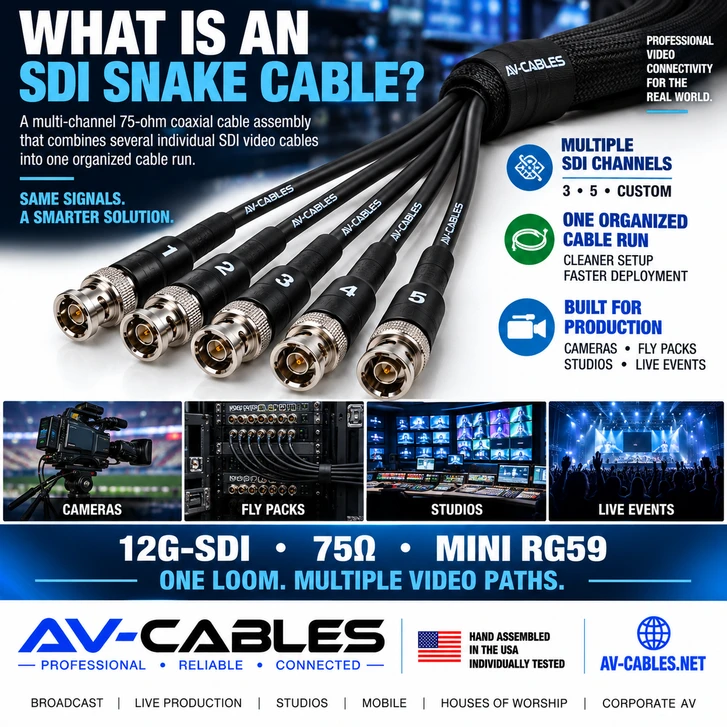
An SDI snake combines multiple professional 75-ohm coaxial cable channels into one organized assembly while keeping each video signal electrically independent.
Here's how they work, where they're useful and what to consider when choosing one.
WHAT IS AN SDI SNAKE CABLE?
An SDI snake cable—sometimes called a BNC snake, video snake or SDI cable loom—groups several individual coaxial video cables into a single manageable assembly.
Instead of deploying multiple loose BNC cables between two locations, the individual channels are bundled together for most of the cable run.
At each end, the channels separate into individual cable tails that connect to the equipment.
For example, a five-channel SDI snake effectively provides five independent SDI paths inside one organized cable assembly.
WHY USE AN SDI SNAKE INSTEAD OF INDIVIDUAL CABLES?
The primary advantage is organization.
Imagine connecting five SDI feeds from a production position to a camera area.
With individual cables, you may need to deploy, identify, route, secure and later coil five separate cable assemblies.
With a five-channel snake, those same signal paths travel together through most of the run.
That can provide several practical benefits:
- Faster setup and teardown
- Cleaner cable routing
- Fewer loose cables across production areas
- Easier channel identification
- More organized equipment racks
- Simpler storage and deployment
- Reduced cable-management complexity
WHERE ARE SDI SNAKE CABLES USED?
Multi-channel video snakes can be useful anywhere several SDI signals repeatedly travel between the same locations.
Common applications include:
- Live production
- Broadcast studios
- Mobile production trucks
- Fly packs
- Camera positions
- Production switchers
- Video routers
- Replay systems
- Monitor walls
- Houses of worship
- Corporate AV
- Sports production
- Event production
HOW MANY CHANNELS DO YOU NEED?
The correct number of channels depends on the equipment and workflow.
For example, a production setup might need separate paths for:
- Camera output
- Program return
- Reference or auxiliary video
- Additional camera feeds
- Monitoring
A three-channel snake may be sufficient for a smaller system, while larger production environments may benefit from four, five or more channels.
When planning the assembly, consider not only today's requirement but whether another video path is likely to be needed later.
An unused channel can sometimes be far more convenient than deploying another separate cable after the system has already been installed or deployed.
WHAT IS A 12G-SDI SNAKE CABLE?
A 12G-SDI snake cable uses coaxial channels designed to support professional 12G-SDI transmission within the rated capabilities of the cable construction and run length.
This makes multi-channel assemblies particularly useful in modern UHD production environments where several high-bandwidth video paths may need to travel together.
AV-Cables builds multi-channel 12G-SDI assemblies using professional 75-ohm coax such as Belden 4855R Mini RG59.
The compact diameter of Mini RG59 helps keep the completed multi-channel assembly more manageable than it would be with several larger coaxial cables.
WHY MINI RG59 WORKS WELL IN MULTI-CHANNEL ASSEMBLIES
Cable diameter becomes increasingly important as channel count increases.
A single larger coax may be easy to handle. Bundle several of them together and the overall assembly can quickly become heavy and bulky.
Mini RG59 provides a useful balance for shorter professional SDI runs because its smaller diameter can help reduce the size and weight of the finished loom.
This can make the snake easier to:
- Route
- Coil
- Transport
- Deploy
- Store
- Manage around production equipment
As always, cable construction must still be matched to the required SDI data rate and transmission distance.
3-CHANNEL VS 5-CHANNEL SDI SNAKES
| Configuration | Best For | Primary Advantage |
|---|---|---|
| 3-Channel | Smaller production systems and camera positions | Compact and easy to deploy |
| 5-Channel | Larger camera and production workflows | Additional signal paths in one assembly |
Neither configuration is inherently better. The correct choice depends on how many independent SDI paths need to travel between the two locations.
DON'T FORGET THE BREAKOUT LENGTH
The overall snake length isn't the only measurement that matters.
The individual channels must separate at each end so they can reach the equipment connectors.
This section is often called the breakout, fanout or tail.
A breakout that is too short may prevent the individual channels from comfortably reaching equipment connectors.
An unnecessarily long breakout can create excess loose cable around the equipment.
When specifying a custom snake, consider:
- Distance between equipment connectors
- Rack width
- Equipment position
- Cable-management location
- Required strain relief
- How frequently the system will be reconfigured
CHANNEL IDENTIFICATION MATTERS
Once several identical black coaxial cables are bundled together, identifying each channel becomes important.
A well-designed snake should make it easy to determine which connector at one end corresponds to the connector at the opposite end.
Clear channel identification can reduce mistakes during setup and make troubleshooting much faster.
This is particularly valuable during live production, where tracing an unidentified cable through a large loom wastes valuable time.
SDI SNAKES FOR CAMERA SYSTEMS
Camera positions are a natural application for multi-channel SDI assemblies because several video signals may need to travel between the camera location and the production system.
A snake can provide multiple independent video paths while allowing the production crew to deploy one organized assembly instead of several loose coaxial cables.
For systems that also require network connectivity, a custom hybrid assembly may combine SDI coaxial channels with CAT6 network lines.
This can be useful for PTZ systems and other production workflows where video and network connections repeatedly travel to the same equipment location.
SDI SNAKE VS HYBRID CAMERA SNAKE
These terms describe two related but different types of assemblies.
| Assembly | Contains | Typical Use |
|---|---|---|
| SDI Snake | Multiple coaxial SDI channels | Multiple video paths between locations |
| Hybrid Camera Snake | SDI plus other cable types such as CAT6 | Video plus network/control connectivity |
WHEN INDIVIDUAL SDI CABLES STILL MAKE MORE SENSE
A snake isn't automatically the best solution for every installation.
Individual SDI cables may make more sense when:
- The signals travel to different destinations
- Routes frequently change
- Only one or two connections are required
- Individual cables need to be replaced independently
- Different cable lengths are needed for every channel
An SDI snake provides the greatest benefit when several signals consistently follow the same physical route.
HOW TO CHOOSE AN SDI SNAKE CABLE
Before ordering, determine:
- SDI format: HD, 3G, 6G or 12G
- Number of channels
- Total cable length
- Breakout length at each end
- Connector type
- Fixed installation or portable production use
- Required cable flexibility
- Whether network channels are also needed
- Whether additional channels may be required later
THE BOTTOM LINE
An SDI snake cable provides a simple solution to a common professional video problem: moving multiple SDI signals between the same two locations without managing a pile of separate cables.
Each coaxial channel remains an independent 75-ohm video path, but the channels are organized into one manageable assembly.
For broadcast studios, live production, camera positions, mobile systems and fly packs, that can mean faster deployment, cleaner cable management and easier troubleshooting.
Choose the number of channels, cable construction, length and breakout configuration around the actual production workflow.
PROFESSIONAL SDI SNAKE CABLES FROM AV-CABLES
AV-Cables manufactures professional multi-channel SDI and custom cable loom assemblies for broadcast, production and professional AV applications.
Available configurations include 3-channel and 5-channel 12G-SDI assemblies, along with custom hybrid configurations combining SDI and CAT6 connectivity.
AV-Cables assemblies are hand assembled in the USA and individually tested before shipment.
NEED A CUSTOM MULTI-CHANNEL CABLE?
Tell AV-Cables the number of channels, SDI format, required length, connectors and equipment application. Custom configurations can be built around your production workflow.
AV-Cables — Professional • Reliable • Connected