
An SDI cable can work perfectly over a short distance but become unreliable as the cable run gets longer. Why does that happen, and how does professional broadcast equipment compensate for signal loss?
Two important technologies help professional digital video systems recover signals transmitted over coaxial cable: SDI cable equalization and SDI reclocking.
Although these technologies are often used together, they perform different functions. Understanding the difference helps broadcast engineers, video technicians, and system integrators choose the right cable and equipment for reliable 3G-SDI, 6G-SDI, and 12G-SDI transmission.
WHAT IS SDI CABLE EQUALIZATION?
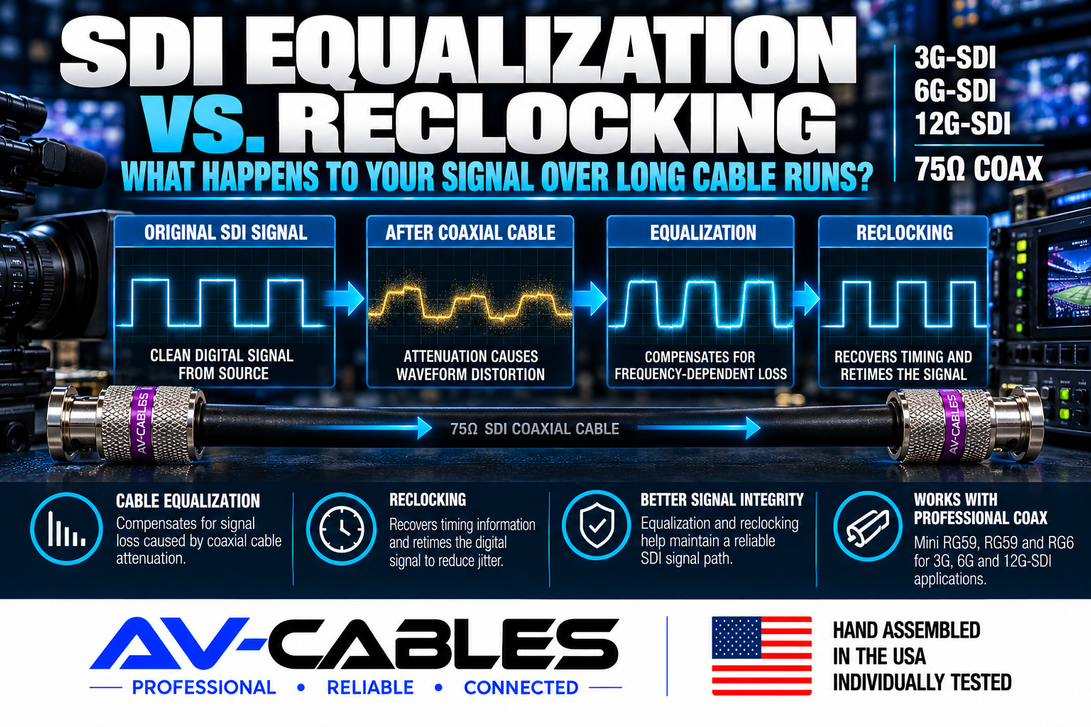
SDI cable equalization is an electronic process that compensates for frequency-dependent signal loss introduced by coaxial cable.
As a digital video signal travels through coax, higher-frequency components generally experience greater attenuation than lower-frequency components. This changes the shape of the received waveform.
An SDI cable equalizer compensates for this distortion, helping the receiver recover the transmitted digital information.
Many professional SDI receivers use adaptive equalization circuitry that automatically adjusts to the incoming signal.
WHY DOES SDI CABLE ATTENUATION MATTER?
Every coaxial cable introduces some attenuation. The amount depends on several factors:
- Cable construction and conductor characteristics
- Signal frequency
- Total cable length
- Operating conditions
- Quality of the complete transmission path
Longer cable runs generally introduce greater attenuation. Higher-frequency signal components also experience greater loss.
This helps explain why a coaxial cable may support a longer transmission distance at 3G-SDI than at 12G-SDI.
AV-Cables offers professional SDI and BNC cable assemblies for broadcast and professional video applications.
WHAT IS SDI RECLOCKING?
Reclocking performs a different function from cable equalization.
A reclocker recovers timing information from the incoming digital signal and uses that timing to retime the data.
This process can reduce timing jitter in the regenerated output signal.
Reclocking is commonly found in professional broadcast equipment such as:
- SDI distribution amplifiers
- Video routers
- Signal converters
- SDI repeaters
- Broadcast interface equipment
Not every SDI device provides reclocking, so always check the manufacturer's specifications.
SDI EQUALIZATION VS. RECLOCKING
| Feature | Equalization | Reclocking |
|---|---|---|
| Primary Function | Compensates for cable-induced frequency loss | Recovers timing and retimes data |
| Primary Concern | Waveform distortion | Timing jitter |
| Typical Location | Receiver input | Receiver or active processing equipment |
| Can Repair Every Cable Problem? | No | No |
WHY IS THIS IMPORTANT FOR 12G-SDI?
12G-SDI carries significantly more data than earlier SDI formats. Higher data rates place greater demands on the coaxial transmission path and receiving equipment.
A cable that operates reliably at 3G-SDI may not provide sufficient performance margin at the same distance when carrying 12G-SDI.
Modern 12G-SDI receivers may incorporate advanced adaptive equalization and reclocking circuitry, but these technologies do not eliminate the need for properly selected cable and connectors.
For compact installations, AV-Cables offers Belden 4855R Mini RG59 12G-SDI BNC cable assemblies.
CAN RECLOCKING EXTEND AN SDI CABLE RUN?
Active SDI equipment incorporating equalization and reclocking can help extend the practical reach of a video system when used within its specified operating limits.
For example, a properly designed SDI distribution amplifier or repeater can recover a supported incoming signal and provide a newly driven output for another cable segment.
However, there is an important limitation:
If the incoming signal has deteriorated beyond the equipment's recovery capability, inserting a reclocker will not automatically solve the problem.
CHOOSING THE RIGHT COAXIAL CABLE
Even with advanced receiver technology, cable selection remains one of the most important factors affecting SDI performance.
Belden 4855R — Mini RG59
Belden 4855R provides a compact coaxial option for professional 12G-SDI applications. Its smaller diameter makes it particularly useful in crowded equipment racks and high-density installations.
Shop Belden 4855R 12G-SDI cables
Belden 4505R — RG59
Belden 4505R offers a professional RG59 construction for 12G-SDI applications, providing a different balance of physical size and transmission characteristics compared with Mini RG59.
Shop Belden 4505R 12G-SDI cables
Belden 4694R — RG6
Belden 4694R is a professional RG6 coaxial option for 12G-SDI applications. Larger coaxial constructions are often selected when lower attenuation over longer cable runs is important.
Explore professional RG6 and SDI cable options
Belden 1855A — 6G-SDI Mini RG59
For 6G-SDI installations, Belden 1855A offers a compact Mini RG59 construction suitable for professional broadcast applications.
DOES A BNC COUPLER PROVIDE RECLOCKING?
No. A standard passive BNC coupler does not contain electronic equalization or reclocking circuitry.
It simply connects compatible coaxial interfaces.
Joining two cables with a coupler does not regenerate the SDI signal or reset the cable-distance budget.
If a coupler is necessary, use one designed for the required video application, such as the Canare BCJ-JK 75-ohm 12G-SDI BNC coupler.
CAN EQUALIZATION FIX A DAMAGED CABLE?
Not necessarily.
Cable equalization is primarily designed to compensate for the expected frequency-dependent losses of coaxial transmission.
It cannot universally correct problems caused by:
- Severely damaged coaxial cable
- Improper connector terminations
- Excessive impedance discontinuities
- Unrecoverable signal degradation
- Unsupported transmission distances
A damaged cable should be inspected and tested rather than relying on the receiver to compensate for the problem.
SDI TROUBLESHOOTING CHECKLIST
- Verify the coax is suitable for the intended SDI format.
- Check the total cable length.
- Inspect BNC, HD-BNC, or DIN terminations.
- Check for unnecessary adapters and couplers.
- Inspect the cable for physical damage.
- Confirm the receiver supports the required SDI data rate.
- Review the equipment's equalization and reclocking specifications.
- Test the complete system at its intended operating format.
For additional troubleshooting guidance, read our guide to nine common SDI signal dropout problems.
FREQUENTLY ASKED QUESTIONS
Is SDI equalization the same as amplification?
No. Equalization compensates for frequency-dependent signal loss. Simple amplification increases signal amplitude without necessarily correcting the distortion introduced by the coaxial cable.
Does reclocking improve SDI signal quality?
Reclocking can improve the timing characteristics of a recoverable digital signal, but it cannot guarantee recovery of data that has already been corrupted beyond the receiver's capability.
Does every 12G-SDI device support the same cable distance?
No. Practical cable reach depends on the coaxial cable, transmitter, receiver, connectors, and overall system conditions.
Can I use a longer RG6 cable instead of Mini RG59?
RG6 may provide lower attenuation over longer runs, but the correct cable depends on the required distance, SDI data rate, equipment capabilities, and installation environment.
THE BOTTOM LINE
SDI cable equalization and reclocking are important technologies in professional digital video transmission.
Equalization compensates for cable-induced signal distortion.
Reclocking recovers and restores digital signal timing.
Both can improve the performance of a properly designed SDI system, but neither eliminates the need for professional coaxial cable, correctly matched connectors, and careful system design.
Whether you're working with 3G-SDI, 6G-SDI, or 12G-SDI, reliable transmission starts with choosing the correct cable assembly for the application.
BUILDING A PROFESSIONAL SDI SYSTEM?
AV-Cables builds professional broadcast cable assemblies using Belden coaxial cable and connectors selected for demanding video applications.
Choose from Mini RG59, RG59, RG6, BNC, HD-BNC, DIN 1.0/2.3, and multi-channel SDI snake configurations.
Hand assembled in the USA and individually tested.
AV-Cables — Professional • Reliable • Connected